Bosham, ancient port, watercolour painting

I sold this painting recently, which is called Evening Glow in Bosham
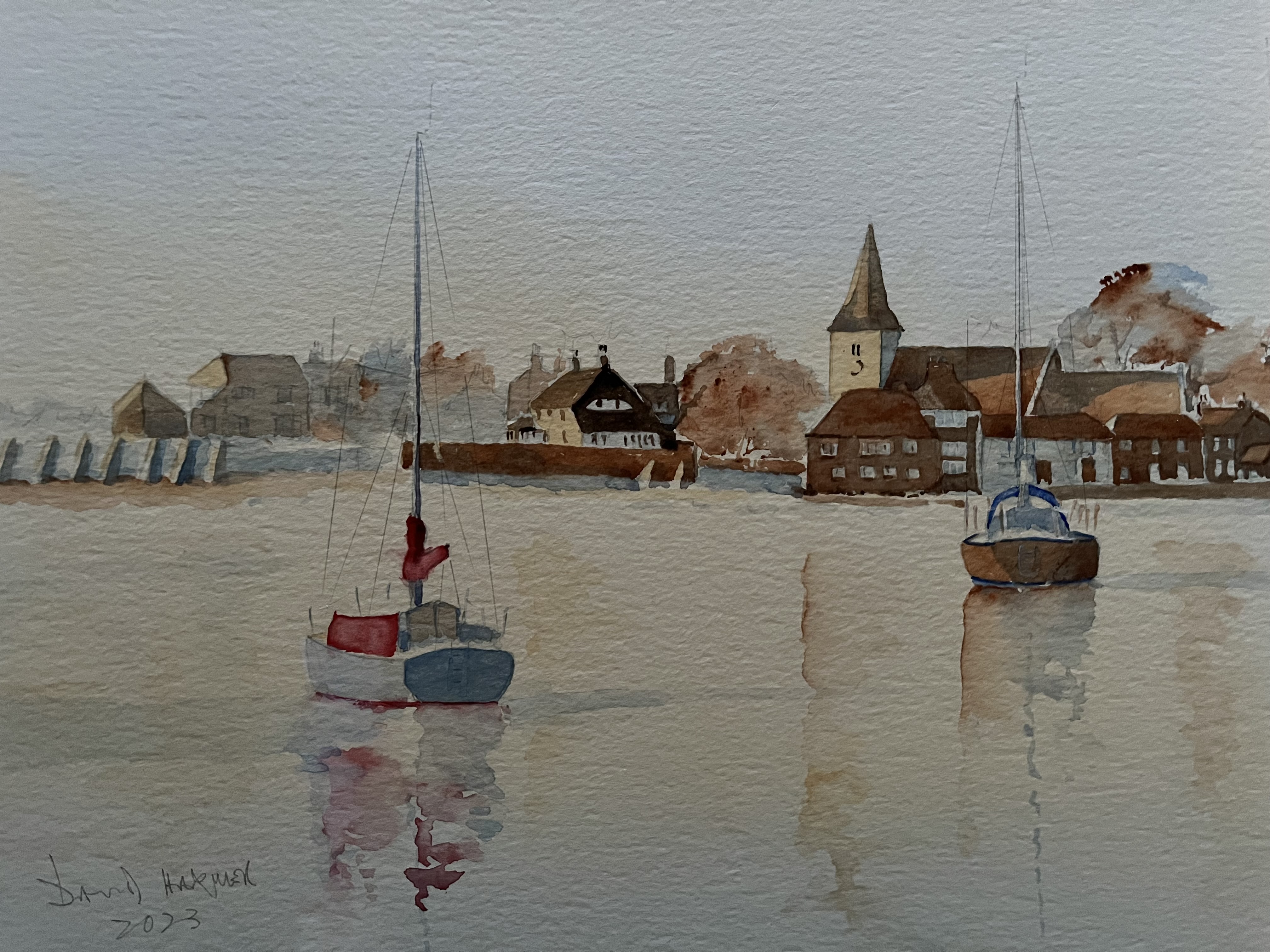
Bosham is a lovely old harbour on the south coast of England. I have painted here many times, always in watercolour, as there is nothing better than watercolour when you are painting the sea, in my opinion

The church is included. It is ancient, from the Saxon period of our history. There is a connection with King Cnut, a Danish king who also ruled over England in the tenth century. It was said that his courtiers told him that he was so powerful, that he could command the waves to go back. The legend goes on that he sat on the shore, told the waves to go back, which they didn’t of course, he did this to show his followers that he wasn’t that powerful. But he was well known here and his daughter is buried in the church.

The church is shown on the Bayeux tapestry. It is shown as a large arch, the chancel arch, which would be as far as the church was built at that time

There is also an association with Harold Godwinson, later to be king Harold, who was defeated at Hastings by William of Normandy in 1066. He sailed from here on his ill-fated voyage to Normandy, and this too is recorded on the Bayeux tapestry.

Today the harbour is used for sailing only, and is a favourite for photographers and painters. For this painting, I tried to capture evening light by using a mix of Raw Sienna and Naples Yellow. I love doing the reflections of the boats, just with splashes of colour on the wet paper. It works and is effortless

I hope you enjoy looking at this painting. The photograph, as usual is slightly darker than the original painting

Turner in Surrey: the River Wey

Turner, Joseph Mallord William; Newark Abbey on the Wey; Tate; http://www.artuk.org/artworks/newark-abbey-on-the-wey-202538

Described as Newark Abbey which is in fact Newark Priory, and even Newark Priory Church. The priory was a huge complex, and the ruined church is all that is left after the Dissolution . It looks to me that Turner sketched this from the road. The view is much the same today. The land is privately owned so close inspection is not possible. Cows are in the field much the same as Turner’s sketch. Newark Abbey is near Ripley as a point of reference. This painting is in Tate Britain

After the dissolution it was said that the priory was bombarded by cannon from nearby Pyrford Hill. After that the site must have been robbed for stone, as the ruined church is all that remains, apart from the odd outcrop

Turner would row down the river. We know that he stayed at the White Lion in Guildford, and at another in inn in Walton-on-Thames. He also thought nothing of sleeping on his boat. He was also a prodigious walker, known to cover 25 miles in a day including making sketches on the way. Sometimes he would set out with company and leave them behind if they couldn’t keep up

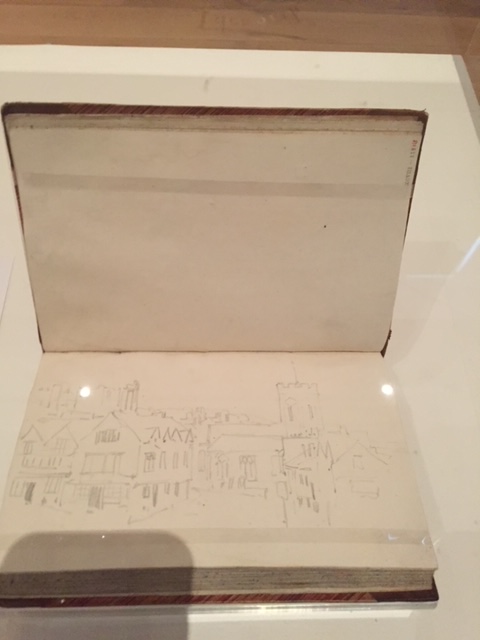
This is the entrance to Quarry Street in Guildford today. It is not by Turner! This is my painting made about twenty years ago. There is a link with Turner albeit a tenuous one. In order to take the reference photograph for this painting, I had to step back into the White Lion Walk in order to keep the bright sunshine out of my lens. The White Lion Walk is the shopping arcade which now stands on the site of the old White Lion Hotel. Let’s look at the next picture.

This is by Turner! It is one of his sketch books and shows the same view which I made years later, which still amuses me. I am sorry the image is so pale, but he worked in pencil. You can see the building on the left is much the same and the ancient church of St Mary stands in the background exactly as it does today On the right hand side is an inn much as today. Turner sketched this whilst staying at the White Lion in Guildford. Was he in the lounge relaxing or in his room. We know he didn’t like an audience so maybe the latter

We’ll leave it there for now and continue Turner’s drift down the Wey at some later date