Sir Brian May’s archive of spectroscopy at Watts Gallery near Guildford

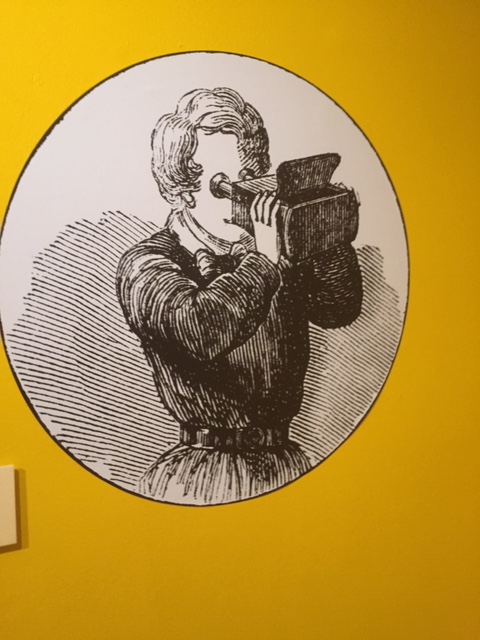
Illustration of boy using a spectroscope

This magnificent collection is on show at the Watts Gallery at Compton just south of Guildford

Watts Gallery, just to set the scene, is or was the gallery used by the famous Victorian portraitist George Frederick Watts. Not only known for his portraits but also his allegorical works, which often commented on the inequalities of the times he lived in. Plus ca change.. Many of his individual works became popular. A painting called Hope I believe is ex President Obama’s favourite painting. Today the gallery houses a considerable collection of his work, but other paintings of his are dotted around international galleries

Nearby is Limnerslease, the house he shared with is wife Mary. The house is open to visitors. Mary supported her husband in his work, but was famous in her own right for setting up manufacture of pottery locally to employ villagers from Compton and also to train them in producing items in clay. Many survive, especially terra cotta plaques for exterior work.

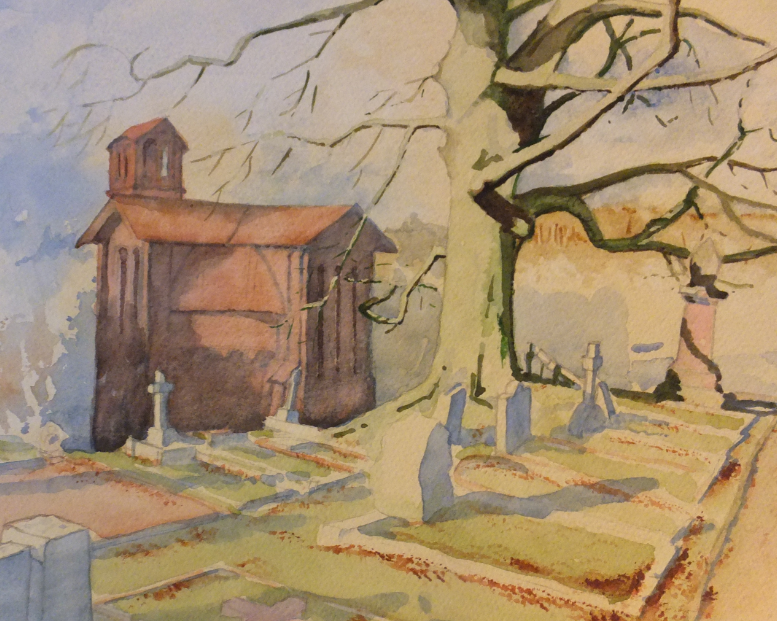
She also had built the magnificent chapel in the nearby cemetery. This was designed by her husband, and is a magnificent example of Art Nouveau design. I attach my own painting, as I don’t have a photograph. Actually I think my painting picked up the mood of the place especially on a winter’s morning

This special exhibition is housed in the main gallery

Sir Brian May started his collection as a boy with a freebie card out of a Weetabix packet. He sent for the viewer, and was amazed by the result in 3D. At the time as I remember, 3D was still high technology. He began taking his own pictures, and one of his father painting the ceiling is shown as an example. He took his pictures with a cheap camera from Woolworths. The name Woolworths has been consigned to history for some time, but it was the place to go for cheap goods. Quite tricky taking a second picture identical to the first, with the technology available at the time.

Having been hooked on the subject, he started collecting Victorian examples when he could find them at boot sales or auction houses. This was very much a Victorian pastime of course and many subjects were produced by card makers like Frith, covering famous names and places and many more

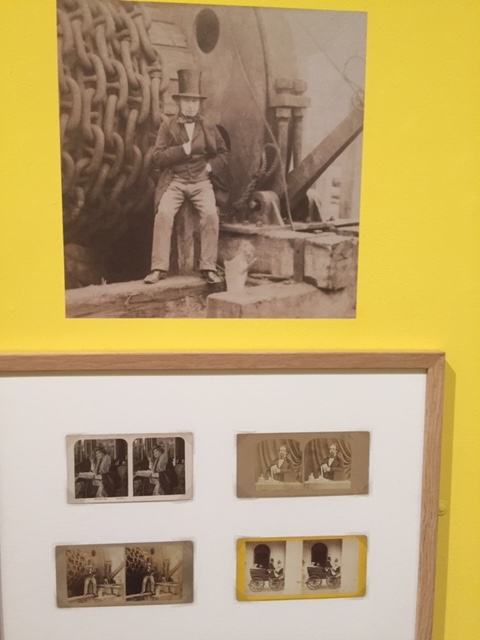
I attach a couple showing the iconic picture of Brunel the railway engineer, photographed alongside his famous steamship the Great Eastern. Also Charles Dickens preparing to deliver one of his readings,

A fascinating subject. I remember 3D as a boy, and being impressed looking at these cards through the viewer. There was also 3D cinema as well, although that was short lived as I remember, being replaced by new technology

Rossetti Exhibition currently at the Tate

The Annunciation by Dante Gabriel Rossetti 1849-50

An early piece by this artist, may even have been his first

The exhibition covered the work and lives of the Rossetti family, from the father Gabriele Rossetti, a political refugee from Italy together with his four children. Gabriele was involved in translating Dante’s Divine Comedy into English, which was a work his children continued after his death. The family were poets and artists. Gabriel Rossetti is well known because of his association with the Pre-Raphaelit Brotherhood, but curiously his sister Christina the poet is better known. She was a prolific writer of poetry. Her poem In the Bleak Midwinter is very well known as a Christmas carol, and would appear in every Christian hymnal, regardless of sect.

Gabriel, his brother William, and five fellow art students founded the Pre Raphaelite Brotherood, the first art group to challenge the soulless painting found in the Royal Academy with its reliance on old master styles. They were to express themselves from their own experiences. They modelled for themselves based on their own interests,and Gabriel drew a portrait of Elizabeth Siddal, a fellow student, and later to be his wife. There is a wonderful collection of her work in this exhibition, as far as I remember the only time that I have seen her work on show. Sadly she caught cold whilst modelling for Rossetti’s painting Ophelia, when she had to lie in a bath of cold water. Colds were treated in those days with laudenum, a mix of opium and alcohol, and it was that that killed her. She was only 39 when she died.

Christina and her sister Maria both chose a single lifestyle. They lived together and worked in the community through an order of Anglican nuns. William would remain single until his 40s when he would marry the artist Lucy Madox Brown.

Christina was to become a celebrity after publishing Goblin Market in 1862 and William became a leading critic and editor alongside his civil service career. Gabriel went on to form a new group: the aesthetic movement , which would change art and design for a second time. he combined working-class women with feminine fantasy inspired by Renaissance portraiture.

The portraits were paired with poems. Double works of art.

Gabriels finalyears were dominated by his obsession with Jane Morris nee Burden. Gabriel met her outside a theatre and asked her to pose as Queen Guinevere. His team included William Morris the designer , as they were painting murals in the Oxford University Union . Morris and Jane were married shortly afterwards and set up house at the Red House at Bexleyheath

Gabriel and William Morris shared the tenancy of Kelmscott Manor, a country house in Oxfordshire. In the early 1870s Gabriel and Jane became lovers

Bosham Harbour and Church- an old favourite

A pale evening glow in one of my favourite places, Bosham harbour, with the Saxon church in the background. The church is featured on the Bayeux tapestry. Harold Godwinson prayed here before setting sail on his ill-fated voyage to Normandy. The church is shown as a large arch, most likely the huge chancel arch still there today. Nave and tower would not have existed then

Reputedly too, the legend of King Cnut attempting to turn back the waves is also supposed to have taken place here. But that is only a story

I painted this view of Bosham as I needed another local painting for an exhibition in Chichester, which is very much a new area for me. I was invited by a local gallery to take part, and I took my paintings down this Monday. The exhibition lasts for three weeks so it will be interesting to see what happens

Chichester is the county town of West Sussex. Very old, its foundation was Roman, and which has a direct link to London by Stane Street which is typically a straight line, although known today as the A24 if I remember correctly. The town centre is beautiful, with its 13c cathedral and 14c market cross.

The painting hopefully shows the harbour with an evening glow. I used quinacredone gold which usually works well

Anyway it is on show with others, and we hope for great things

Painting Westminster Abbey

Westminster Abbey

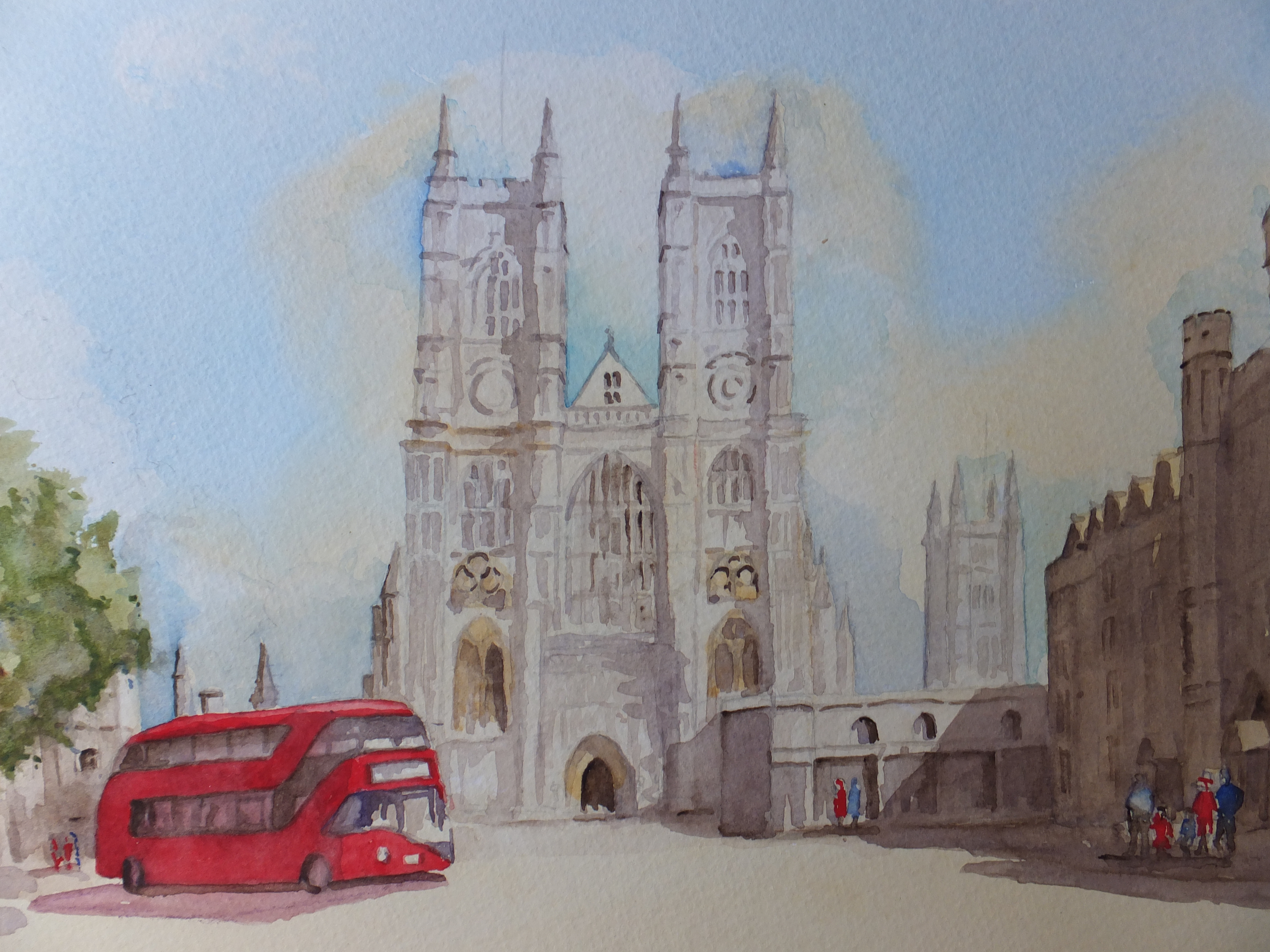
Not inspired by the coronation, because I have looked at this amazing abbey for some time, as a possible painting. A lot of architectural detail which I love to have a go at. I work by allusion. I could not reproduce all the detail exactly, especially with a brush. I put in some detail, some shading and get the colour as close as possible to the original stonework, which is a pinky grey colour, and this seems to work. I sometimes think that the eye of the neholder finishes off the image and fills in the gaps that I have left.

I sorted through various photographic references. I had plenty to choose from. Part of the facade was obscured by two buses and other traffic. There is a column of pink granite in front of the abbey which I felt was in the way, so just left it out. I took out one bus and moved the other one as far left as I could manage, and painted in the red livery that you expect of a London bus. As far as I could see, this is one of the new Routemasters. I am not an expert. I just eclipsed the abbey with the bus, just to show they belonged in the same picture, not placed together artificially. I felt they worked together. I echoed the red with pedestrians in different parts of the composition.

St James Palace on the left I put in heavy shadow, much heavier than the photograph reference. I liked the effect. The spotlight was now on the abbey. The tower of the Houses of Parliament I painted in very pale violet. The image faded away, giving an impression of distance.

I felt satisfied with the composition. The facade of the abbey needed some work. I sharpened some of the detail on tracery, and put extra shadow in to let the eye see where everything was. I don’t do much more than that. The allusion is complete. The eye of the viewer can fill in what is missing

The painting is finished . I would have preferred not to introduce green but there was a tree which couldn’t be left out. This painting will be shown next month in Chichester where I have been invited by a gallery to take part in an exhibition. So a new area which I am looking forward to.

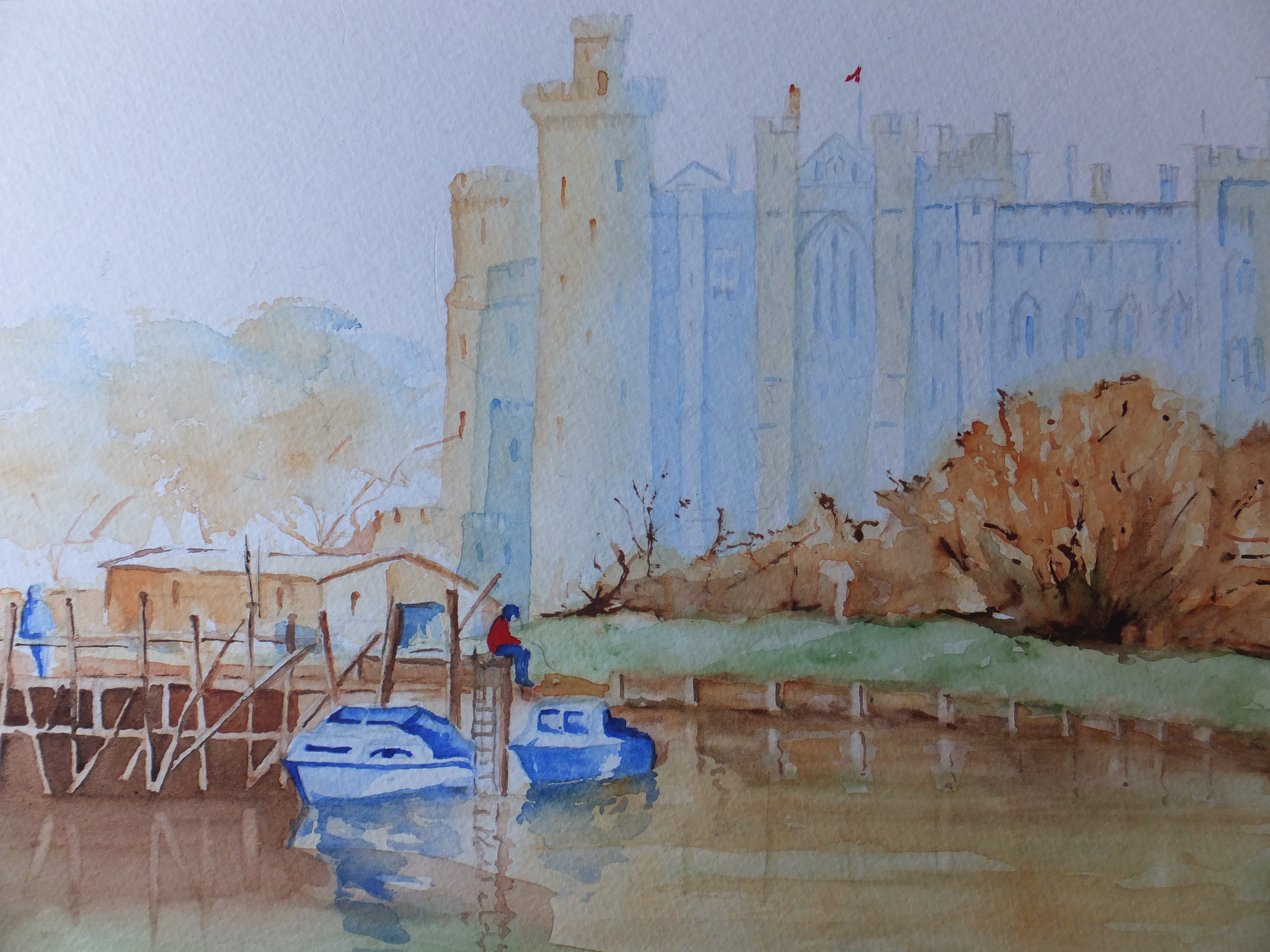
Arundel Castle in Sussex

A view of a mistry Arundel castle across the River Arun

Probably one of the best-known castles along the south coast, Arundel castle is ancient but largely restored in the c19.

Arundel is the seat of the Norfolks, who would have moved here from Framlingham during the c16. A family with close association with the monarchy, their fortunes rose and fell throughout history.

In 1485, at the battle of Bosworth, they were on the losing side, and lost the Norfolk title. They reverted to the earldom of Surrey.

In 1513, they regained their title of Dukes of Norfolk, after defeating a Scottish Army at Flodden Field in Northumberland. The Scots had invaded England after Henry VIII had invaded France. Catherine of Aragon had despatched the Earl of Surrey northwards to meet the Scottish Threat. After an ingenious manoeuvre whereby the English worked their way round the Scottish position during the night, they approached the Scottish Army from the north, whilst the Scots were entrenched facing south

The result was a massive slaughter of the Scottish nobility including the king James IV, whose body was taken to London and put on show. Scottish losses were about 30,000

The Earl of Surrey was restored to his old title of Duke of Norfolk.

The Norfolks were and still are the leading Catholic family in the land. Their fortunes changed with the religious struggles in the 16c

Today they are often in charge of large events like coronations, and doubtless will be this year too

Two Camargue Stallions

Firstly I am indebted to Wendy Hodgkins Corniquet for her excellent reference photograph

I find it hard to resist Camargue horses and when I saw this picture, I felt that it would work well as a painting

The only thing I changed was the background. The photograph had a background more like a sunset, which I have changed to something plainer. I felt that concentrated more on the horses.

Camargue horses as you know, run wild in the wetlands in the Rhone estuary. They are always white, which adds to their impact as a herd, especially galloping through water.

I have painted them many times, as featured on my web site davidharmerwatercolour.co.uk

Two Langstone Swans

I am grateful to Vicky Stovell of Smiley Sunshine Photography for the use of her amazing photograph as a reference

I was intrigued by the photograph, not just for the composition bu also for the effects of the colours, which I hope that I have done some justice to. Yet another superb sunrise over the sea photograph to work to, yet challenging whilst exhilarating

The colours seemed to go in bands. Deep yellows and pinks in the lower sky beneath the blue, which are then repeated in reverse order through the horizon and into the sea, finishing with blue around the swans as we get into shadow.

The pebbles were time consuming. There were a variety of colours amongst the stones, blues and browns which I have tried to pick out, whilst at the same time, subduing the effect slightly so as not to compete with the detail of the birds. Something of a balancing act. Have I been successful. I will let others judge

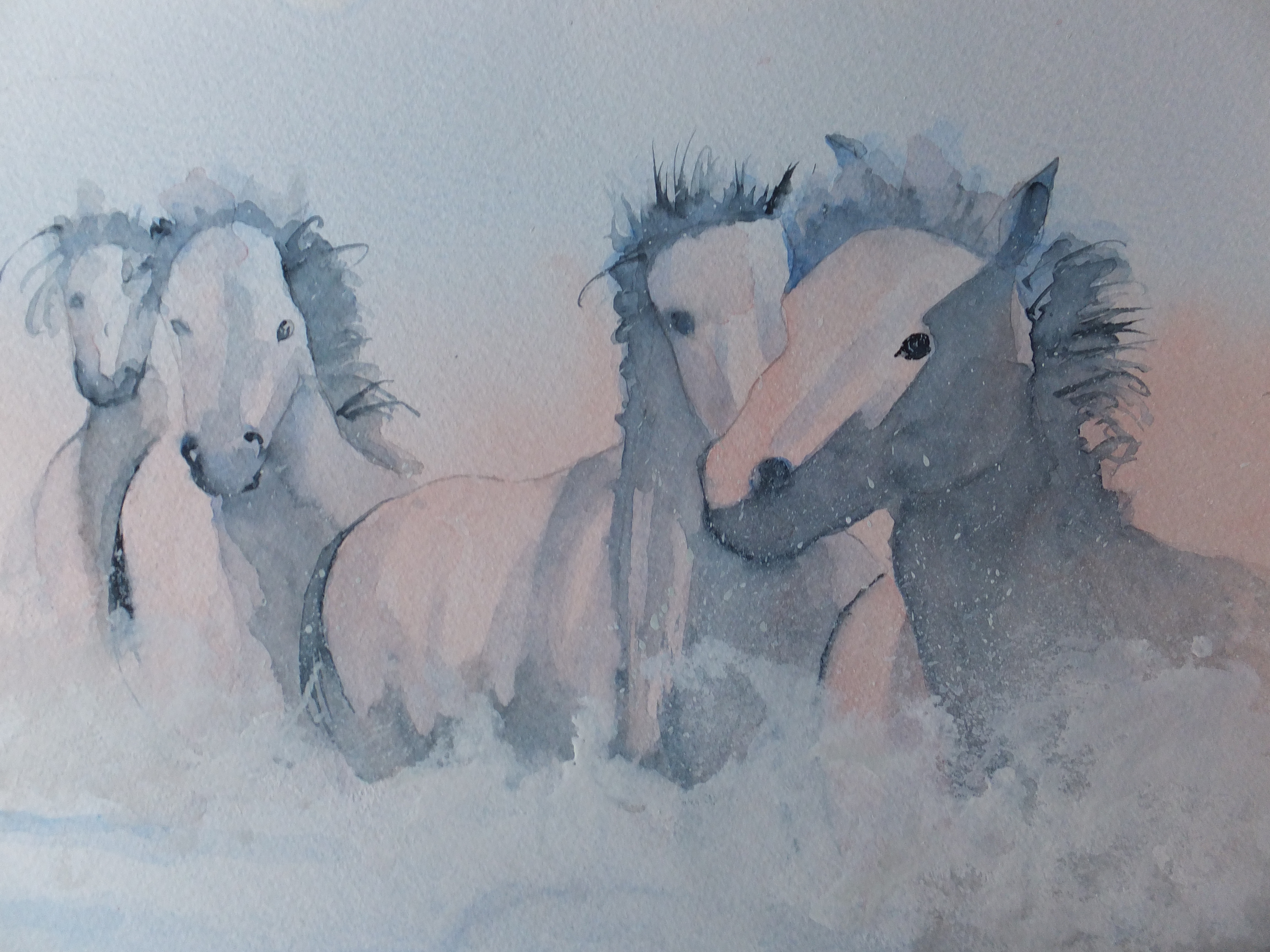
More Horses in the Wetlands

I have trieed a different image and with it a different style

I was intrigued by this image, having decided in my mind to give horses a rest for a while. I was struck by the simplicity of the subject, and wanted to capture that. Detail has been kept to a minimum. Despite the activity, the horses seem calm. The water is churned up, yet the painting gives a feeling of peace

I think this is a painting that you can look at for quite a long time.

Others may disagree which is fair comment

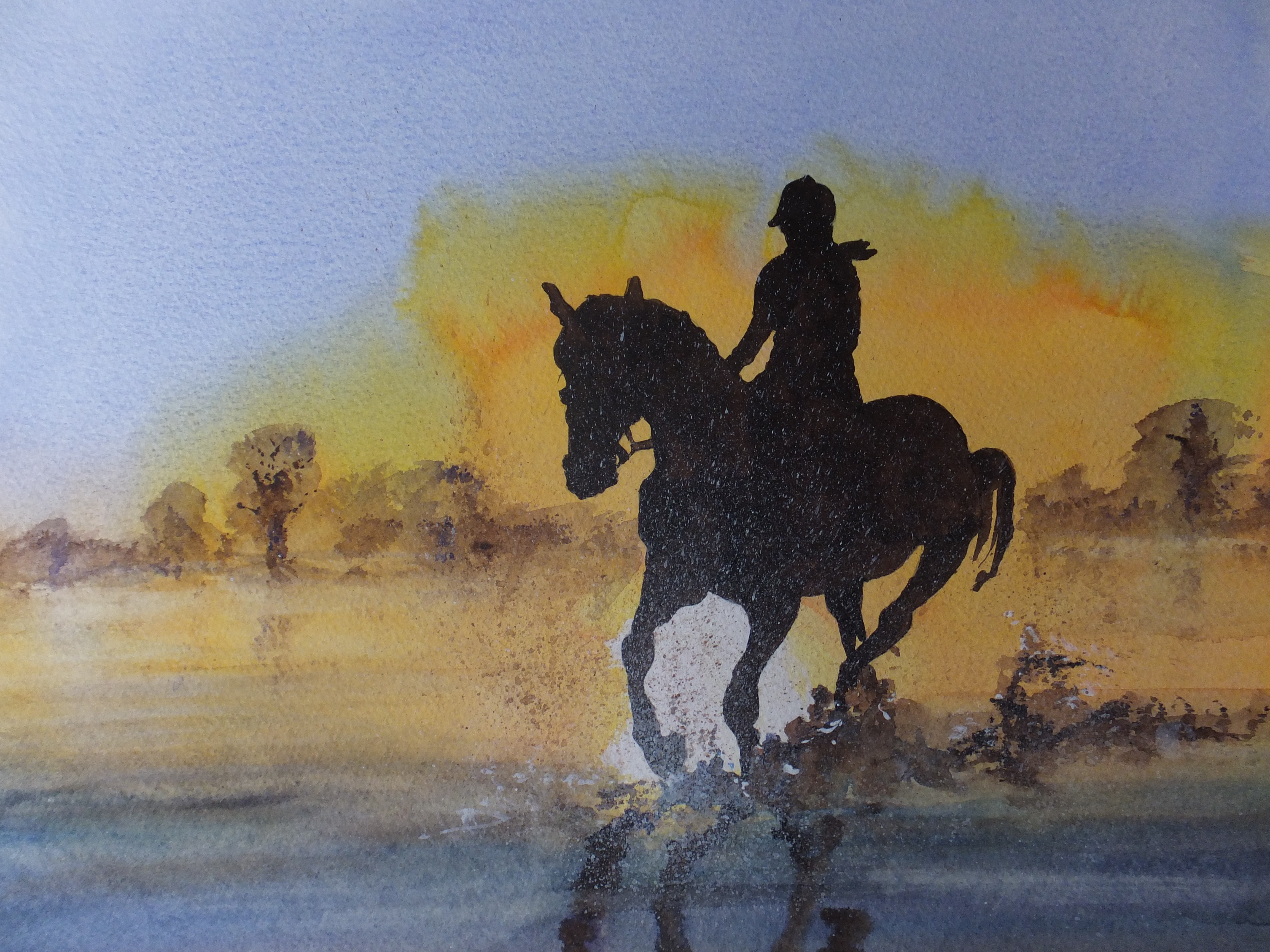
Horse and Rider

I would first like to acknowledge with thanks Rebecca Photography on Pixabay who kindly allowed me to use her reference photograph, when preparing this watercolour painting

I like, as many will know, painting horses and horses in water. This image intrigued me and presented problems from the start. Horse and rider were a complete silhouette. So? Well, there were no details to help me with the drawing or very few at least. It was difficult, if nigh impossible to check my measurements as I proceeded with the drawing. Likewise the rider, which I don’t normally include but they were the same image. They could not be separated. If you have ridden horses, and I have a little when I was younger, you will know that you have to adopt certain attitudes or body shapes, otherwise you will just fall off. Legs must be in the right place for example. You can’t see the legs in this image so what to do?

I ended up doing a separate drawing of the horse with rider showing her legs and stirrups. I had to match the correct leg position with the rest of her body. That took me some time. It was quite a long time of experimentation, before I was ready to paint. Sky and water were comparatively straightforward in comparison. I had to give horse and rider two coats of burnt umber before I had a perfect silhouette.

I must have done something right. The painting sold on its first announcement

I would have liked her for my current show at Denbies Wine Estate but you can’t have everything, and anyway you can only sell a painting once

I hope you enjoy looking and reading my blog

The Dreaming Spires of Oxford

The Dreaming Spires of Oxford

Our grandson went up to Oxford about a year ago. He sent us a postcard during his first term. The view was of the dreaming spires which was an ideal picture for painting. All those old favourites, Tom Tower and the Ratcliffe Camera plus a few that I’ve forgotten

A tremendous amount of national history took place in Oxford. The university is one of the four oldest in Europe, and I believe that Merton is the oldest college, although happy to be corrected on that score. I haven’t been there for years, unfortunately. I remember in the cathedral, there is the notch in the wall which supported the dais on which Cranmer sat during his trial.There was only one outcome to this trial. He was going to burn. Queen Mary had already decided. She hated him for the way that he had treated her mother, Catherine of Aragon in the past. And, of course, burn he did, and the spot is still marked.

During the Civil War that followed about a century later, Oxford was the seat of the King and the Royalist Party. London had declared for Parliament.

In this painting, I struggled to capture the soft light on the honey-coloured stone, and hopefully a quiet peaceful atmosphere. Others may judge me on that score

I haven’t shown this painting publicly yet. My first opportunity is at the end of this month, when I show with the Village Artist at Denbies Wine Estate near Dorking, Surrey. They have been kind in the past, so we shall have to see what the reaction is.